📌 QUICK SUMMARY
Speech delay is one of the most common developmental concerns in toddlers. The good news? There is so much you can do at home — alongside professional support — to help your child find their voice. This guide walks you through 8 expert-backed home strategies, warning signs to watch for, and when to seek professional help.
You are at the playground, watching your little one happily dig in the sandbox. Nearby, another child of the exact same age runs up to their mother and chatters away in full sentences. Suddenly, a familiar wave of worry washes over you. “Why isn’t my child talking like that? Did I do something wrong?”
If this scenario sounds familiar, take a deep breath. You are not alone, and you have not done anything wrong. It is incredibly common for parents to worry about their child’s communication milestones. Toddler speech delay is one of the most frequent developmental concerns parents face today.
The good news is that children develop at their own unique pace, and there is so much you can do right in your living room to help them find their voice. While professional speech delay treatment is the gold standard for long-term progress, building a language-rich environment at home creates the perfect foundation for your child to thrive.
In this guide, we will explore what a speech delay is, what signs to look for, and practical, expert-backed strategies you can start using today.
📋 IN THIS ARTICLE
What Is a Speech Delay?
To put it simply, a speech delay happens when a child’s language development is tracking behind the expected milestones for their age group. It is important to understand the distinction between speech and language here.
Speech refers to the physical act of making sounds and forming words. Language, on the other hand, is the broader ability to understand and communicate meaning. A child can have a delay in speech, in language, or in both.
There are many reasons why a child might experience a delay. Sometimes, it is simply a matter of individual developmental variation — some kids walk early, others talk early, and neither is better. Other times, a delay may be linked to hearing loss, oral motor challenges, or other developmental differences.
No matter the cause, understanding that your child is struggling and then actively seeking knowledge — as you are doing right now — is the single most powerful thing you can do for them.
Speech Delay Signs You Should Watch For
Knowing the developmental milestones for speech and language is the first step in identifying a potential delay. Here is a simplified guide based on typical developmental patterns:
⚠️ SPEECH MILESTONES TO WATCH
- By 12 months: Your child is not yet babbling, pointing, or using any meaningful gestures.
- By 18 months: Your child does not have at least 6–10 single words (like “mama,” “dada,” “no,” or “milk”).
- By 24 months: Your child is not putting two words together (like “more milk” or “big dog”) or only imitates speech without producing their own spontaneous words.
- By 36 months: Your child’s speech is highly unclear, even to close family members, or they struggle to follow simple, two-step directions.
If you notice any of these signs, try not to panic. Recognizing them is simply the first step toward empowering your child with the skills they need.
Home Strategies to Improve Speech Delay
If you are waiting for a professional evaluation or just want to give your late talker a gentle push, there are many evidence-based activities for speech delay that you can weave into your daily routine. The key is consistency and making it feel like play, not therapy.
Narrate Your Daily Activities (Parallel Talk)
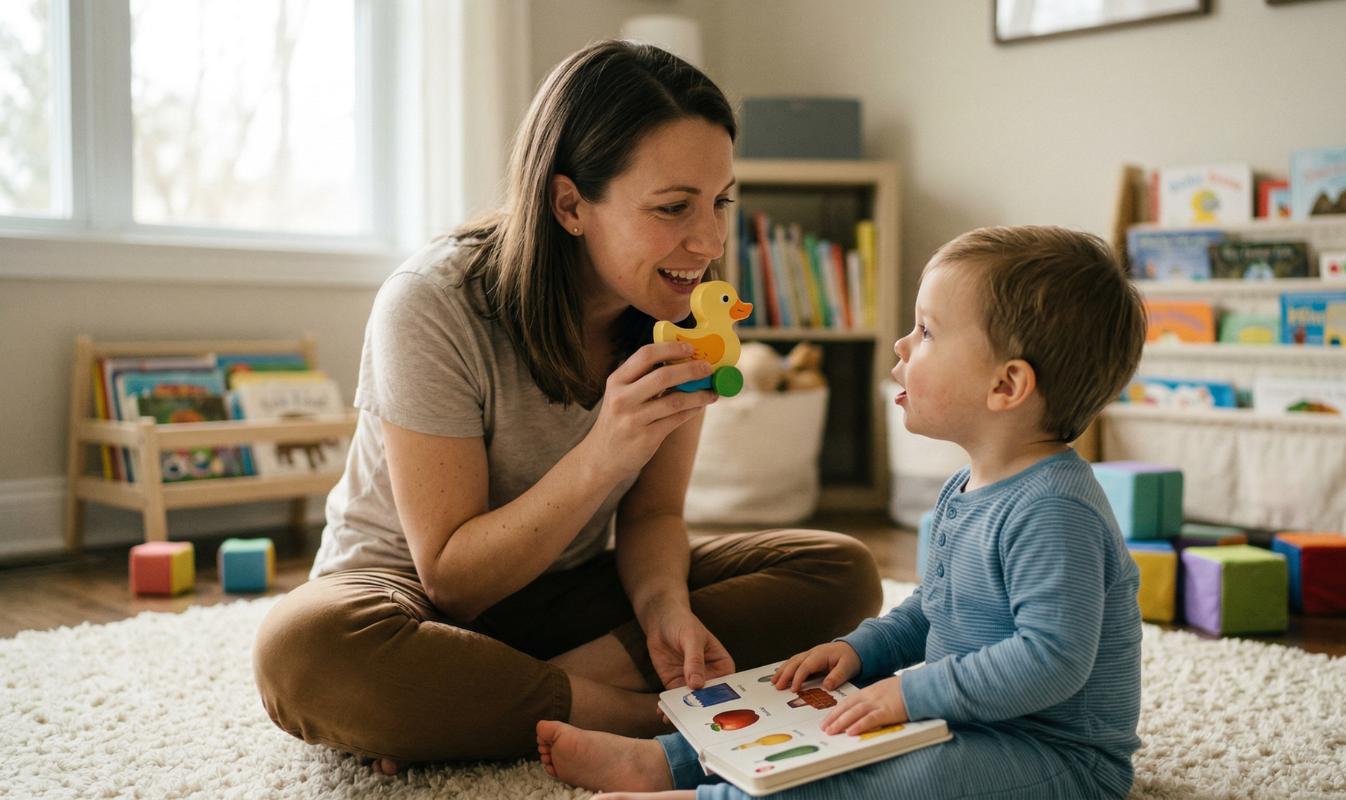
One of the most powerful and easiest activities you can do is simply talking to your child as you go about your day. This is called “parallel talk.” Instead of asking your child questions or waiting for them to speak, you narrate what is happening in simple, clear sentences.
When you are getting your child dressed, you might say, “Here is your blue shirt. We are putting on your shirt. Now your arms go through. Done!” When cooking, say “I am stirring the soup. It’s hot! I smell dinner.”
💡 Why it works: You are flooding your child’s brain with language models. Children learn to talk by hearing talk. The more rich, descriptive language they are exposed to, the more raw material they have to eventually produce their own words.
Read Aloud and Bring Stories to Life
Reading to your child is one of the oldest pieces of parenting advice, and for a very good reason. It is one of the most effective ways to accelerate language development.
When you read, do not just read the words — make it an event. Use different voices for different characters. Point to pictures and name what you see. Ask simple questions as you go, like “What is that?” or “Where is the dog?” Even if your child cannot answer yet, you are building the crucial skill of joint attention — the ability to focus on the same thing as another person. Choose books with repetitive phrases (like “Brown Bear, Brown Bear, What Do You See?”) so your child can begin to anticipate and eventually fill in the words.
💡 Why it works: Reading exposes children to a wider vocabulary than they would encounter in everyday conversation, builds listening comprehension, and reinforces the fundamentals of story structure and communication.
Reduce Background Noise and Screen Time
In the modern home, noise is constant. The television is often on in the background, music is playing, and smartphones are always nearby. While technology has its place, for a child developing language skills, constant background noise is a significant obstacle.
To learn language, children need clear input. When the TV is on, a child’s auditory system is competing to separate the meaningful speech of their parents from the background chatter of the screen — and they often lose. Experts, including the American Academy of Pediatrics, recommend limiting screen time for children under 2 to video chatting only, and for children aged 2 to 5 to no more than one hour per day of high-quality programming.
💡 Why it works: Reducing noise creates a cleaner auditory environment, making it easier for your child to hear, process, and ultimately produce language. The quiet moments of one-on-one connection are where the most learning happens.
Encourage Fun Imitation Games
Imitation is the cornerstone of language development. Before children produce words, they learn by copying the actions and sounds of the people around them. You can actively encourage this skill through playful imitation games.
Get down to your child’s eye level and start by imitating them. If they bang the table, you bang the table. If they make a sound, you make it back. Then, gradually introduce new actions and sounds for them to copy. Clap your hands and wait for them to clap back. Make an exaggerated “achoo!” sound or a silly animal noise like “moo” or “baa.”
💡 Why it works: Imitation is a fundamental building block of speech. By keeping it playful and low-pressure, you are teaching your child the concept of back-and-forth turn-taking, which is essential for eventual conversation.
Note: If you feel overwhelmed trying to implement these strategies alone, remember that expert guidance is available. Families looking for dedicated support can visit SoundBee to explore how professional therapists can partner with you in your child’s journey.
Sing Nursery Rhymes and Songs
Music and language share deep neurological connections in the developing brain. Singing is one of the most enjoyable and effective language-building activities you can do with your child.
Classic nursery rhymes like “Twinkle Twinkle,” “Old MacDonald,” and “Wheels on the Bus” are popular for a reason. Their rhythmic, repetitive structures make them easy for children to anticipate and eventually participate in. Use hand gestures and body movements to pair physical actions with words, which significantly aids in retention.
💡 Why it works: The melody and rhythm of songs act like a “hook” that helps language stick in a child’s memory. Singing also slows down speech, making individual sounds and words easier to discern and process.
Create Opportunities for Communication
One of the most counterintuitive things you can do to encourage speech is to sometimes wait. As parents, we are incredibly good at anticipating our child’s needs. We see the reach toward the cup and hand it over before they have had a chance to ask.
Instead, create moments of “communicative temptation.” Put a desired toy on a shelf just out of reach. Hand them something they do not want — the wrong shoe, for instance — and wait with an expectant expression. Put a small amount of food on their plate and wait for them to request more. These are not moments of frustration; they are invitations to communicate.
💡 Why it works: Communication requires motivation. By not always anticipating their needs, you create a genuine desire for your child to express themselves — which is the engine that drives all language development.
Respond to and Validate Non-Verbal Cues
Language begins long before words do. Your child is communicating constantly through pointing, reaching, facial expressions, and vocalizations. Responding to these cues enthusiastically and warmly is one of the most foundational things you can do.
When your child points at a bird, do not just say “yes.” Say “Bird! You see the bird? That’s a little brown bird. It’s flying!” This practice, known as “language expansion” or “extending,” takes whatever communication your child offers and builds upon it, modeling more complete language.
💡 Why it works: It teaches your child that their attempts to communicate are valued and effective, which builds confidence and motivates them to keep trying. It also constantly provides a slightly more advanced language model for them to reach toward.
Use Simple, Clear, and Exaggerated Language
The language you model for your child should be a little above their current level, but not too far above. This “scaffolding” principle means meeting them just at their edge of understanding.
If your child uses no words, model single words. If they use single words, model two-word phrases. Keep your sentences short, slow, and clear. Use an animated tone — a higher pitch, wider facial expressions, and clear enunciation. Exaggerate the key words you want them to learn. This is sometimes called “child-directed speech” or “motherese,” and research confirms that babies and toddlers find it significantly easier to process and learn from than standard adult speech.
💡 Why it works: Simplified, exaggerated speech is specifically tuned to the developing brain’s ability to process language. It highlights the most important information and makes it easier for children to segment words from the flow of speech.
When Home Strategies Are Not Enough
Home activities are meant to supplement, not replace, structured therapy. If you have been consistently applying these strategies for a few weeks and are not seeing any progress, or if your child’s delay is significant, it is time to seek professional guidance.
🚨 SEEK PROFESSIONAL HELP IF:
- Your child is not meeting the milestones listed above after consistent effort at home
- You notice a loss of previously acquired skills (regression)
- Your child shows no interest in communicating at all
- There are concerns about hearing ability
- You have a gut feeling that something is off
A certified speech-language pathologist will be able to perform a comprehensive assessment to identify the type and degree of any delay, and then create a personalized intervention plan.
Why Choose Professional Speech Therapy?
Choosing the right professional support can feel overwhelming, but working with a certified speech-language pathologist offers something that no amount of home practice can fully replicate: a precise, individualized diagnosis and treatment plan.
This is where finding a trusted, local center becomes vital. If you are looking for speech therapy in Trivandrum, finding a clinic that takes a holistic, child-first approach is essential.
Soundbee offers a warm, child-friendly environment where certified professionals work with both the child and the family. The approach at Soundbee is not just about drilling sounds or words in isolation — it is about helping children develop confident, functional communication skills that serve them for life.
PROFESSIONAL SUPPORT
Ready to Take the Next Step?
Our certified speech-language pathologists at SoundBee create personalized treatment plans designed for your child’s unique needs.
📞 Book a Free ConsultationGive Your Child the Gift of Communication
Watching your child struggle to express themselves is one of the hardest things a parent can experience. But it is crucial to remember that a speech delay is not a life sentence. With the right environment, the right strategies, and the right professional support, children make remarkable progress.
Remember, early intervention is the key to unlocking your child’s potential. Professional speech therapy, especially when started young, has a very high success rate in helping children meet and often exceed their communication milestones.
Do not wait and wonder. Take the next step toward supporting your child’s development. Every word they learn is a gift you give them — a tool they will use for the rest of their life.
📌 KEY TAKEAWAYS
- Speech delay is common and not your fault — many factors contribute to it
- Early recognition of milestones helps you act sooner
- Home strategies like parallel talk, reading aloud, and imitation games make a real difference
- Reducing screen time and background noise creates a better language-learning environment
- Professional therapy is the gold standard — home activities support but don’t replace it
- Every small effort you make builds your child’s confidence and communication skills
🐝 SoundBee Speech & Hearing Clinic
Trivandrum’s trusted center for speech and hearing care
Certified speech-language pathologists • Child-friendly environment • Personalized care